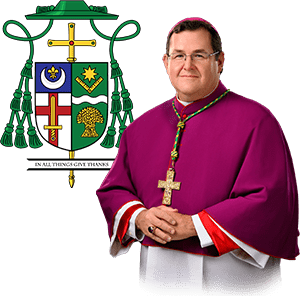
A message from Bishop John Iffert

Bishop_Iffert_300x296Lent 2026

My homilies and pastoral reflections are almost always a product of what I have seen and heard in the days and weeks prior. It is true again as I sit to think with you about how to enter the season of Lent in 2026.

This past Sunday I joined with others to pray for peace during a Holy Hour at the Cathedral Basilica of the Assumption. I was amazed at the number of people who came out to pray late in the afternoon on Super Bowl Sunday with little notice or planning. I was taken by the profuse expression of appreciation I received for providing this opportunity to pray for peace in our hearts and minds, in our families, our Church, our communities, our nation and world. Many people seemed eager for an opportunity to bring their concerns to the Lord and to be led in turning our minds and hearts toward the mind and heart of Christ — who always greets his disciples with assurances of peace.

Just a week before that Holy Hour for Peace, the Church gave us the Beatitudes as the Gospel for the Fourth Sunday of Ordinary Time.

It is with these experiences in mind that I invite myself, and you, to consider shaping our Lenten practice this year by asking how we might contribute to the peace that Christ wishes for his Church and his world. I propose to focus on the first three of the beatitudes as an entry-point for this Lent: poverty of spirit, mourning, and meekness of heart.

Poverty of Spirt is another way to speak of freely chosen humility. Humility is that virtue that clearly recognizes that every good has its origins in God and gives due deference to the debt of gratitude and worship owed to God for his graciousness. It works against the corrupting influence of pride, self-aggrandization and entitlement that can eat away at the individual, the community or the nation that indulges in self-promotion. In the end, it works against the kinds of idolatrous attachments to honor, greed, power and pleasure that lead to a “We-They” oppositional and acquisitional view of the world. It works against the kinds of attachments that can be taken as causes for (I might say excuses for) self-assertion, manipulation, violence and war.

We might focus on humility this Lent by adding the Litany of Humility to our daily prayer. Perhaps we could fast from something we take particular pride or delight in. It might be a type of food or drink that is luxurious, but it might also be a piece or type of clothing for which we get particular compliments, our impressive pen than draws attention in business meetings, or anything that speaks to us of high status or our own accomplishment.

We might take up a daily practice of gratitude, identifying each day an additional reason to be grateful for a gift that is important to us and our success, that ultimately came to us as gift — like a supportive family, educational opportunity or being born into a society that respects the rule of law. As an expression of gratitude and devotion, we might make a sacrificial gift of talent or treasure to assist those who have not so benefited.

It has been said that the virtue of humility is first in Jesus’ list of Beatitudes because it is the virtue that is necessary for the development of all other human virtue. It works for the establishment of the Kingdom of Peace by fostering a healthier sense of self that is not in competition with others for honor, respect or any other good. It is the foundation for the edifice of temperance, prudence, fortitude and justice.

Mourning our griefs and losses in healthy and holy ways acknowledges our own limits, fosters reliance on God, and can lead to a greater awareness of and identification with others who suffer. Joining others in mourning their losses fosters understanding, cultivates gentleness, and leads to accompanying others through the most sensitive and susceptible of times. It is an imitation of Christ who emptied himself out to join our human state and accompany us through the dark valley.

This Lent we might embrace this beatitude by finally seeking help in processing our own profound losses or traumas that have in some way held us captive. A skilled counselor or spiritual director (or both) can be incredibly helpful on this journey. Prayer that acknowledges our own pain and helps us turn to the assurance of God’s accompaniment may, over the long term, open us to sensitive accompaniment of others.

Considering the sufferings of those we count as opponents (or even enemies) can build the virtue of understanding. Meditate on the losses of someone on the other side of a local, national or international issue and take the time to respect their losses and pain. Is there a way to acknowledge their grief and consider how it might cause us to adjust our worldview, or at least the kinds of rhetoric we employ?

Offering practical, unrequested assistance to one who is mourning the loss of a loved one, of their own mobility and liberty, or of a forfeited dream, is a particularly profound kindness. Perhaps a Lenten effort might be to finally develop a concrete response that we can offer a neighbor at the time of a loss.

Many people offer gifts of food. When my mother died, a crafty friend made us a set of notecards and a lovely list for recording delivered food and gifts. The package came with a personal note offering to help us with the dozens of thank-you cards we would face in coming days. A non-judgmental cup of tea with a friend who feels isolated and needs a listening ear is an offering unto the Lord. Taking time this Lent to find a way to respond to a neighbor’s grief and preparing to put this compassionate response into motion, might be a terrific Lenten discipline.

Meekness is the most misunderstood of all human virtues. It is unfortunate that our English word rhymes with “weakness.” Meekness is nothing of the sort. It is the virtuous capacity to endure hardship, and even injustice, without giving way to our baser instincts and desires. Meekness helps us to maintain our higher and holier faculties. It helps us control our tongues for the sake of maintaining relationships. It empowers us to take deep breaths, avoid rage and the emotional backlash that stems from anger. Meekness helps us forego revenge and it promotes charity. Meekness is integrity and STRENGTH!

This virtue allows space for respect, the protection of the dignity of the other, and for considering the other’s perspective with a loving and appreciative eye. It keeps us from jumping to hasty conclusions and actions. Meekness allows us to avoid reacting from our woundedness and instead to see more as God sees and respond more from the heart and mind of Jesus.

To grow in meekness, pray for the gift, of course. It may also be fruitful to consider the last few times we have grown angry and reflect on what was at stake for us when we lashed out. A daily examen that focuses on moments of anger or pique — and the corresponding sense of self-righteousness that can flood us in anger’s wake — may lead us to consider more productive ways to respond. Developing a concrete plan — turning to God, taking a walk, or counting to 10 — might help us develop the habit of meekness. If anger is a particular issue for us, we might enter a season of regular, weekly Confession with an emphasis on the moments we have lost our cool and our ability to respond from a Christ-centered place. Of course, daily reception of Communion with the intention of becoming conformed to the One who is meek and humble of heart would be a wonderful Lenten practice.

I have come to think that these three virtues — poverty of spirit, mourning and meekness — are first in Matthew’s list of Beatitudes because they are foundational to the development of all human virtue. They are building blocks along the way of becoming temples of God’s mercy and peacemakers after the heart of Jesus. Wouldn’t it be amazing if we and our whole society might foster these virtuous capacities!

Whatever Lenten observance we choose, may it lead us to become instruments of the peace Christ wills for his people and his Church. May the Holy Spirit guide you and pour out blessings upon you in this sacred time.

+Bishop John Iffert

Current Events

Ky Bishops Epiphany Satement on Immigration

On the Feast of the Epiphany, Jan. 4, the Bishops of Kentucky release a statement on immigration standing with “all of our immigrant brothers and sisters who have been victimized by unjust government action or by harmful rhetoric and vilification.”

Read the entire message here English and Spanish.

Franciscan At Home

The Diocese of Covington is partnering with Franciscan University’s Catechetical Institute to offer quality faith formation for everyone in the diocese. Click here to be directed to the registration page and list of courses.

Seminary Ball 2025

You don’t want to a miss a thing! Stay up to date on events and happenings as together the bishop, priests, and people and of the Diocese of Covington develop a strategic pastoral plan and leaders.

Featured News

St. Thomas Adoration Chapel to celebrate 25 years as ‘heart’ of parish

Maura BakerStaff WriterIn 2001, St. Thomas Parish, Ft.…

How do I …

In the Diocese of Covington, before contracting the services of an extern (from outside the diocese) priest or deacon, man or woman religious, or lay person a request for verification in good standing must be submitted to the Chancery. Click here and you will be directed to the Chancery’s webpage where you can download and submit the proper form.

You’re engaged — congratulations! Visit the Office of Catechesis and Evangelization page and click on the quick link “Programs for Engaged Couples” for answers to your questions.

The Office of Catechesis and Evangelization offers a variety of adult faith formation classes throughout the school year and during the summer. These classes are also required as part of the catechist certification process and formation for aspirants to the permanent diaconate. For information and the schedule of classes Click Here.

The Tribunal Office is available to help with the annulment process.

Employment opportunities for diocesan administrative positions, principals, teachers, and other parish and school positions can be found by clicking here.

The Archives of the Diocese of Covington offers assistance in obtaining sacramental records and other genealogical information.

New Beginnings is the diocese’s Separated and Divorced ministry. Click here for more information.